

In the heart of Cheyenne’s historic Rainsford District stands the Wyoming Historic Governor’s Mansion, a stately residence that has long mirrored the ambitions and evolution of America’s Equality State. Constructed in 1904, this 6,000-square-foot structure served as home to Wyoming’s top executives for over seven decades, encapsulating political history and domestic life under one distinguished roof.
Today, the mansion has been repurposed into a living museum, allowing visitors to explore rooms restored to various decades between 1905 and the 1960s. The site offers more than architecture—it provides an immersive experience of the people, policies, and social shifts that shaped Wyoming’s formative years.
Key Takeaways
-
Built in 1904, the mansion showcases Colonial Revival architecture by Charles Murdock.
-
Served as residence to 19 governors, including Nellie Tayloe Ross, the first woman U.S. governor.
-
Now a public museum, it displays domestic life from the early 1900s to the 1960s.
-
Features original amenities like hot-water heat and combination gas-electric fixtures.
-
Underwent a major restoration in 2004, preserving both historical accuracy and public access.
A Historic Legacy: From Construction to Cultural Symbol
Built just fourteen years after Wyoming achieved statehood in 1890, the original Governor’s Mansion reflects the state’s bold identity and progressive vision. Designed by Charles W. Murdock of Omaha, the mansion was completed in 1904 at a cost of $33,253, including landscaping. With indoor plumbing, hot water heat, and dual gas-electric lighting, the home boasted features that were cutting-edge for its time.
Strategically located at the corner of 21st Street and House Avenue, the building’s lack of fencing symbolized open governance and accessibility to the public. Its setting among other Victorian-era homes helped form the Rainsford Historic District, adding to the mansion’s architectural and civic importance.
After serving 19 governors, the mansion was decommissioned as a residence in 1976 and reopened in 1977 as a museum, providing a carefully preserved glimpse into political and domestic life across generations.
Colonial Revival Elegance: Architectural Significance Through the Ages
The mansion is a distinguished example of Colonial Revival architecture, a style that became popular in the early 20th century for its symmetrical form, classical columns, and traditional ornamentation. Murdock’s design emphasized proportion and balance, incorporating white clapboard siding, pedimented windows, and shuttered facades that echoed early American colonial ideals.
The interior layout was practical yet refined, with rooms large enough for official entertaining but modest compared to more opulent executive residences in other states. The original carriage house, still standing, remains part of the preserved property.
In 1969, the mansion was added to the National Register of Historic Places, cementing its architectural and historical value. A 2004 renovation led by preservation architects ensured that original features were conserved while interpretive updates—such as signage and room restorations—allowed for better public engagement.
Pioneering Equality: Home to America’s First Woman Governor
Among the many figures to reside at the Governor’s Mansion, Nellie Tayloe Ross holds a special place in history. Sworn into office on January 5, 1925, she became the first female governor in the United States. Her appointment followed the untimely death of her husband, Governor William B. Ross, and her election reflected Wyoming’s long-standing reputation as the Equality State.
Ross brought progressive values to the mansion, advocating for banking reforms, prohibition enforcement, and agricultural relief, though many of her policies were stymied by a Republican-controlled legislature. Despite these challenges, her tenure helped redefine women’s roles in politics and public leadership.
After her time in Wyoming, Ross went on to serve as Director of the U.S. Mint from 1933 to 1953, appointed by President Franklin D. Roosevelt. Her legacy continues to inspire women in politics and public service.
Transformation: From Gubernatorial Residence to Public Museum
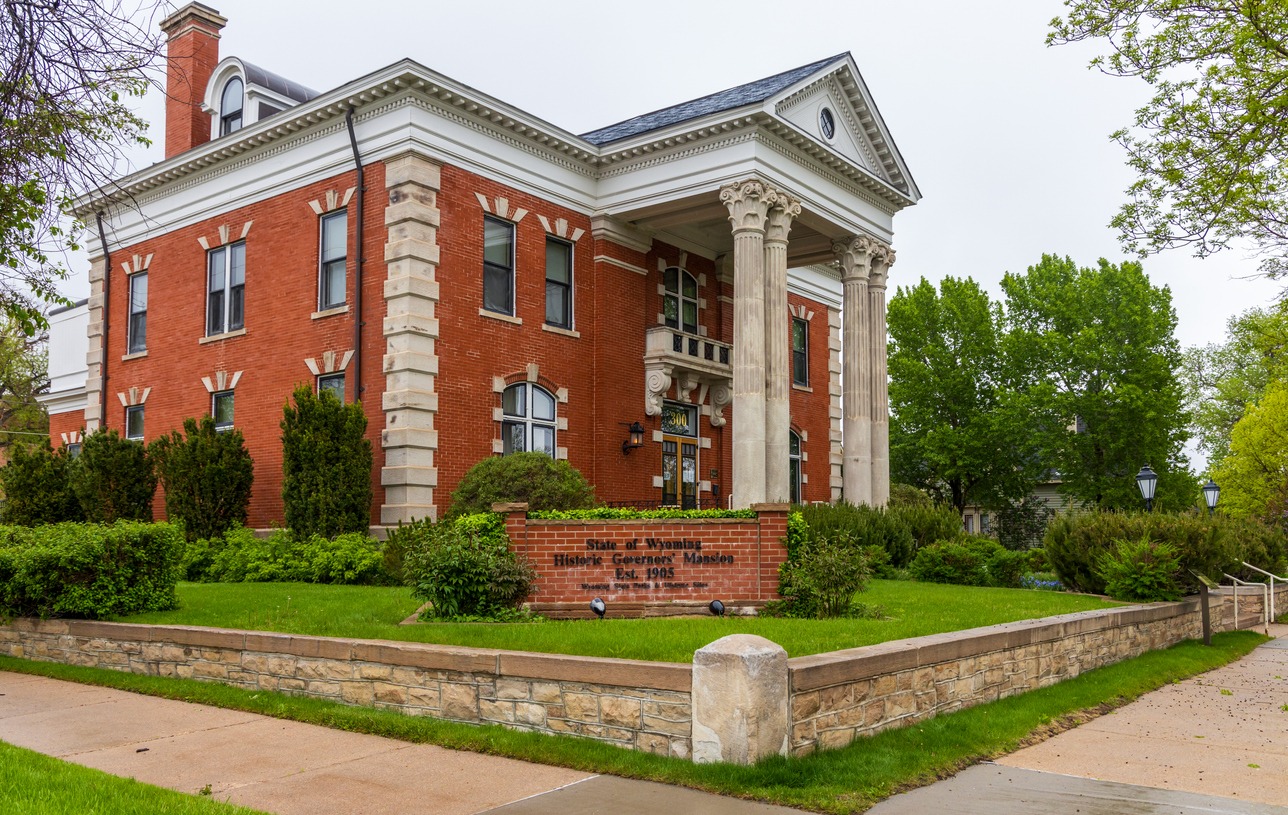
When Governor Ed Herschler moved into a newly built residence in 1976, the historic mansion found new life as a public institution. By 1977, it was officially opened to the public as the Historic Governor’s Mansion State Historic Site, operated by Wyoming State Parks & Cultural Resources.
The interior rooms were meticulously restored to reflect styles from four key decades—1905, 1937, 1955, and 1960s—offering visitors a walk through the changing aesthetics and technologies of each period. The museum’s exhibits are enhanced with interactive displays, touchscreen kiosks, and authentic furnishings, making history accessible to all ages.
One of the mansion’s most unique features is a Cold War-era fallout shelter installed in the basement in 1959, serving as a sobering reminder of the nuclear fears that shaped mid-20th century domestic life.
Preservation in Practice: Restoring Wyoming’s Architectural Heritage
The 2004 restoration, spearheaded by architect Kurt Dubbe, brought the mansion’s historical features back to life. Every detail—from period wallpaper to original light fixtures—was chosen to replicate the building’s past eras with accuracy and respect.
Preservationists employed conservation methods that safeguarded original materials, including the mansion’s gas-electric chandeliers, decorative trim, and hardwood flooring. The plumbing and heating systems, considered state-of-the-art in 1904, were also restored or replicated to illustrate early 20th-century domestic infrastructure.
Through this meticulous work, the mansion stands today not just as a museum, but as a symbol of Wyoming’s dedication to preserving its political and architectural legacy for future generations.
Timeless Pillars of Equality and Civic Pride
More than just a stately home, the Historic Governor’s Mansion in Cheyenne serves as a living archive of Wyoming’s political evolution, architectural legacy, and commitment to equality. Its transformation from a private residence to a public educational space illustrates the power of preservation in fostering civic identity.
Whether exploring the elegant parlor of 1905, the mid-century fallout shelter, or learning about the life of Nellie Tayloe Ross, visitors walk away with a deepened appreciation of the state’s role in shaping American democracy. In every timber and tile, the mansion preserves the pioneering spirit that has defined Wyoming since its earliest days.