

Nestled within the heart of Capitol Square in Richmond, the Virginia Governor’s Mansion is more than just the official residence of the Commonwealth’s governor—it is a testament to enduring leadership, classical design, and civic tradition. Built during the early days of the American republic, it remains the oldest continuously occupied executive mansion in the United States. Since its first residents crossed its threshold in 1813, the home has silently witnessed two centuries of political transformation and social evolution.
This Federal-style mansion has welcomed governors, dignitaries, royalty, and everyday Virginians. Behind its stately façade lies a complex narrative of public service, architectural legacy, and modern adaptation. With its carefully preserved interiors, vibrant restoration efforts, and stories etched into every detail, the mansion remains one of Virginia’s most compelling symbols of continuity between past and present.
Key Takeaways
- The Virginia Executive Mansion, completed in 1813, is the oldest continuously occupied governor’s residence in the U.S.
- Designed by Alexander Parris, the building showcases classic Federal-style architecture on Richmond’s Capitol Square.
- Over 55 governors have lived in the mansion, including James Barbour, Patrick Henry, and Anne Holton.
- Distinguished guests have included Queen Elizabeth II, Winston Churchill, and multiple U.S. Presidents.
- Major restorations, notably in 1999, balanced historic preservation with ADA accessibility and sustainability.
The Path to America’s Oldest Continuously Occupied Governor’s Home
The story of Virginia’s executive residences began in colonial Williamsburg, where the Governor’s Palace housed British-appointed governors until its destruction during the Revolutionary War. When Virginia moved its capital to Richmond in 1780, early governors operated out of modest accommodations until the Virginia General Assembly approved construction of a permanent residence in 1811. The legislation was signed into law by then-Governor James Monroe, who would later serve as the fifth President of the United States.
Construction began under the design of Boston architect Alexander Parris, who blended neoclassical ideals with the American Federal style. By 1813, the mansion was completed, and Governor James Barbour became its first official resident. Unlike earlier buildings that served temporary functions, this mansion marked a decisive moment in Virginia’s assertion of a stable, symbolic seat of executive power. Today, its uninterrupted occupancy distinguishes it as a rare architectural survivor—and a living witness to American governance.
Federal Elegance: Architecture and Design Elements
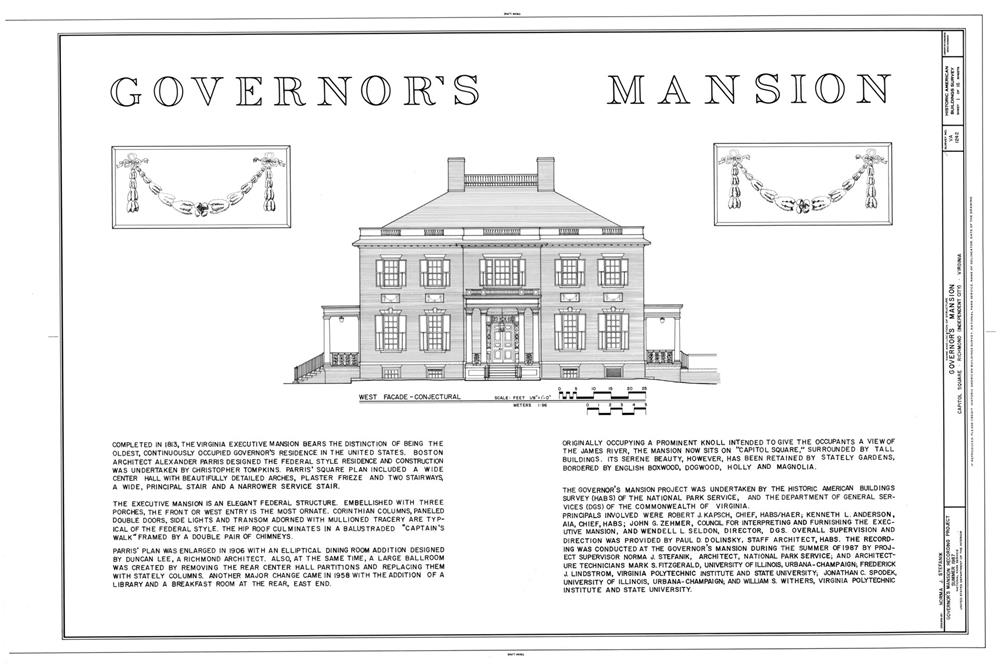
Designed by Alexander Parris, the Virginia Executive Mansion is a definitive example of Federal-style architecture, a style prominent in the post-revolutionary United States. The building’s symmetrical five-bay façade, constructed from red-painted brick, is anchored by a subtly projecting central bay topped with a classical pediment. A Corinthian portico, added in later years, graces the entrance with understated grandeur while preserving the integrity of Parris’s original design.
Inside, the mansion features a central hallway flanked by formal rooms with decorative plaster friezes, high ceilings, and period woodwork. A principal staircase ascends gracefully to the upper floors, while a secondary service staircase maintains the historical division between public and private areas. Thoughtful alignment with the Virginia Washington Monument reinforces the mansion’s axial prominence on Capitol Square—a layout reportedly inspired by Thomas Jefferson’s architectural philosophy, which emphasized civic order and classical harmony.
The property has undergone minimal structural change over time, preserving its authentic Federal character even as internal systems have been upgraded. While modern landmarks like Fallingwater celebrate harmony with nature, the Governor’s Mansion exemplifies the geometric precision and symbolic authority of early American civic architecture.
Famous Footsteps: Notable Residents and Visitors
Since its completion in 1813, the mansion has served as home to over 55 governors, each leaving a unique imprint on its legacy. Among the earliest residents was James Barbour, known for his influential role in both state and national politics. Patrick Henry, though not a mansion resident, was a foundational figure in Virginia governance, helping lay the political groundwork that the mansion would later symbolize.
The mansion has hosted a wide array of distinguished guests over its two centuries, including Queen Elizabeth II, King Edward VII (when he was Prince of Wales), Winston Churchill, and several U.S. Presidents, such as Rutherford B. Hayes and Grover Cleveland. In a modern twist of personal history, Anne Holton uniquely lived in the mansion both as a governor’s daughter and as First Lady, highlighting the home’s role as a multigenerational stage of public service.
From royal visits to presidential receptions, these events have transformed the mansion into more than a residence—it is a venue where national and international relationships intersect with Virginia’s ongoing political story.
Preserving the Past: Restoration and Renovation Efforts
Over the years, the mansion has undergone several preservation efforts aimed at maintaining its historic integrity while adapting to the needs of modern governance. One of the most comprehensive renovations occurred between 1998 and 1999, spearheaded by First Lady Roxane Gilmore. With a budget of approximately $5 million, the project focused on structural reinforcement, period restoration, and ensuring ADA accessibility—without compromising the mansion’s Federal-era aesthetics.
This renovation restored much of the mansion’s interior detailing, upgraded mechanical systems, and improved public access for guided tours. The project even gained national recognition when it was featured on PBS’s “This Old House”, showcasing the complexities of preserving historic authenticity amid modern challenges.
Earlier restoration campaigns included early 20th-century updates by architect W. Duncan Lee, who introduced new entertaining spaces like a formal dining room and ballroom. Each phase of renovation has reinforced the mansion’s dual mission: preserving its role as a living historic site while adapting to the practical needs of a working executive residence.
The Mansion’s Role in Virginia’s Political History
Throughout its more than two centuries of service, the mansion has stood as both the symbolic and functional heart of Virginia’s executive branch. Every major administration since Governor Barbour’s has relied on the mansion as a space for formal receptions, policy discussions, and ceremonial events. While it serves as the private residence of the sitting governor, it also functions as an active political venue.
One of the most notable modern moments came in 2006, when Governor Tim Kaine delivered the Democratic Party’s response to the State of the Union from the mansion’s ballroom. That moment, broadcast nationally, reaffirmed the mansion’s relevance not just in architectural history but in contemporary civic life.
Its enduring presence links centuries of Virginia’s governance, from early statehood debates to present-day public service, making it an integral part of the Commonwealth’s political narrative.
Behind the Columns: Daily Life and Public Access
Despite its grandeur, the mansion has always been a home—a place where governors and their families live, host, and reflect. Historic records reveal the rhythms of daily life: staff managing domestic affairs, preparing meals, and maintaining order for both family routines and state functions.
In the 19th century, the mansion was supported by a mix of paid staff and enslaved individuals. The central figure in daily operations was often the butler, who supervised household workers, greeted guests, and managed logistics for state dinners and social events. These roles gradually evolved with time, adapting to the expectations of each era.
Today, the mansion opens its doors to the public through guided tours, allowing Virginians and visitors alike to explore its rooms and learn about its legacy. The balance between public accessibility and preservation is delicately maintained—ensuring that modern guests experience not just a building, but the living history within it.
Where History Lives: Virginia’s Lasting Executive Home
The Virginia Governor’s Mansion is more than a relic—it’s a living symbol of governance, culture, and continuity. As the oldest continuously occupied executive residence in the United States, it reflects the architectural ideals, political milestones, and personal stories that have defined Virginia for over two centuries. With every passing administration, it gains new layers of meaning, blending the dignity of the past with the needs of the present.
Whether welcoming royalty, hosting legislation-shaping meetings, or greeting schoolchildren on a field trip, the mansion remains a vital part of the Commonwealth’s identity—a cornerstone where heritage meets leadership.